What to Consider for the Return of an Athlete After an Injury
Return to sport has become a surrogate outcome mensurate for athletes afterwards injury but does it mean what yous think it means?
It'due south understandable why return to sport has become a widely used effect measure for athletes later on injury as information technology'due south commonly the motivating factor for surgery or rehab.
Unfortunately there is no standardisation or widely accustomed definition for when an athlete has returned to their sport leading to inaccurate comparisons of interventions also as challenges in managing athletes expectations.
Go Started in Sports Physiotherapy
At that place is besides a tendency for return to sport to be reported equally a binary measure – returned to sport or did non. This doesn't reflect the circuitous clinical course after injury and begs the question should a spectrum or continuum exist a better mode of budgeted return to sport?
A new systematic review published in the Orthopaedic Periodical of Sports Medicineaimed to evaluate and written report the differences in specific definitions and meaning of 'return to sport' in orthopaedic sports literature. So let's have a look at what was found.
Methods – Is This a Good Systematic Review?
This systematic review (SR) adhered to 2020 PRISMA guidance however information technology was not pre-registered on PROSPERO which means in that location could be some reporting bias nowadays within the review.
The databases searched were PubMed, EMBASE and Cochrane Trials which should exist adequate to go broad coverage of most published literature yet this could exist improved by including a sport database such as SportDISCUS.
Information technology isn't clear when the search took place and the full search strategy isn't available however at that place is a full description of keywords used and their combinations, explosions and boolean operators.
"return to sport" ("return to play," "RTS," "RTP," "Return to Sporting Activities," "Return to Sporting Activity," "Resumption of Sporting Action," and "Resumption of Sporting Activities"), "orthopedic procedures" ("orthopedic process," "orthopedic surgery," "orthopedic surgeries," post op*, surger*, "surgical," "reconstruction," arthroscop*, and "orthopedic") and "define" ("defines," "definition," "defined," and "defining")
Just manufactures published in English language were included within the review and only abstracts were searched which means manufactures which included return to sport (or it's variants) wouldn't have been included inside the review all the same this is a practical limitation as it would have been overwhelming otherwise.
Articles were included if they studied athletes who had undergone orthopaedic surgery for a sport related injury however it doesn't explicitly say which study blueprint is included rather a long list of studies which are excluded.
2 authors independently performed the search with a third available to reach consensus over nay disagreements throughout the search procedure. As the aim of the study was to provide a clarification of the variation used for the term 'return to sport', rather than data analysis, no analysis on quality or bias was performed.
Overall this is an 'ok' systematic review with limitations likely because of resources and time limitations still the lack of reporting of a clear search strategy in full for each database should be present.
What Does Return to Sport Hateful?
In total 29 studies were included within the descriptive review with a full breakdown of these articles fully bachelor. The articles included within the review covered a wide diverseness of sports with hockey, football, baseball, basketball game, American football and throwing sports across several levels of participation and ages.
The surgeries reported included arthroscopic labral repairs in FAI, ACL reconstruction, achilles repairs, hind foot arthroscopy, shoulder impingement arthroscopy, Lisfranc repair, clavicle fixation also as hand and finger tendon repair. This diversity in both sport and injury repair suggests that the broad approach to search strategy was effective.
The variability in terminology used to describe return to practice or return to play was surprising with the post-obit terms used:
- Return to sport
- Return to play
- Return to athletic activity
- Render to competitive play
- Return to sporting activities
- Favourable return to sport outcome
In terms of what this means and the definition of these terms at that place is even more variability with return to sport meaning annihilation from the following list:
- Playing in at to the lowest degree ane game of the athletes sport of the start game afterward surgery
- The offset regular flavor played subsequently surgery
- The first preseason or regular game played after surgery
- The get-go regular or mail service season game played after surgey
- Specification of competition level
- Return to training
What Term and Definition Should Exist Used Instead?
T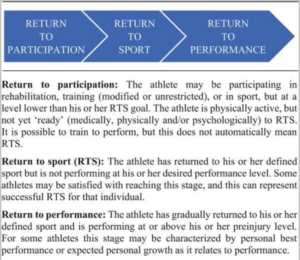 he authors of the systematic review advocate for the use of the continuum of return to sport,created by Ardern et al, which explicitly states the the athlete's recovery status. This continuum more accurately reflects the variable course of an athletes return to sport.
Looking at this model there are some implications to consider such every bit the definition of performance is largely subjective and ofttimes is determined by the athlete than objective measures.
Additionally if this model was adopted widely as the standardised approach taken by researchers, there will be a higher number of athletes returning to sport however it does provide context every bit fewer will return to operation. Therefore this provides greater clarity and context and is a more reliable measure of 'render to sport'.
Source: https://www.physiospot.com/research/what-does-return-to-sport-after-injury-really-mean/
0 Response to "What to Consider for the Return of an Athlete After an Injury"
Post a Comment